
At the end of When Harry Met Sally, Billy Crystal needs to get to Meg Ryan and tell her what they both already know: that, in the words of the song crooned over this final scene, ‘It Had to Be You’. Problem is it’s New Year’s Eve, and Ryan’s Sally is partying like it’s 1989, i.e. without the distractions of a mobile phone. And since, for once in the film, this means she’s away from a landline, and since in New York on New Year’s Eve you can’t seem to get a cab, Crystal’s Harry needs to go by foot. Which is when he starts to run.
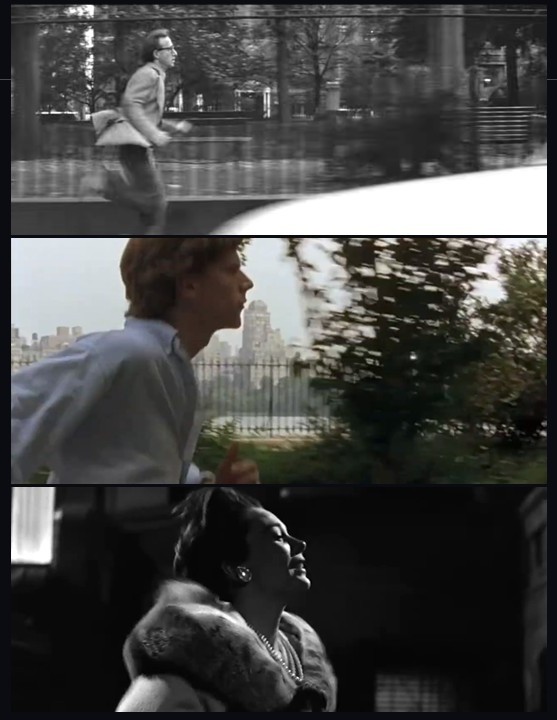
As the actor and podcaster Lucas Hare recently pointed out to me, this conclusion to When Harry Met Sally sits in a triangular conversation with two earlier generations of New York City film. In Billy Wilder’s The Apartment (1960), Shirley MacLaine’s Fran Kubelik is the one leaving the party, as well as a sleazy Fred MacMurray, to run to Jack Lemmon’s lonely C.C. Baxter. In Woody Allen’s Manhattan (1979), meanwhile, Allen’s comedy writer Isaac realises he’s made the mistake of his life in dumping his girlfriend, Tracey. It’s not New Year’s Eve but, as is often the case in Allen’s or anyone else’s New York, the streets are so jammed, and young Tracey’s off to London any minute to study acting. And so, in what remains a rare and therefore cherishable moment in Allen’s long oeuvre, Woody starts to run.
Beyond the cross-referential pleasures provided by these three endings, they also offer that quintessentially cinematic pleasure of watching bodies running through space (the word ‘cinema’, it’s worth remembering, comes from cinématographe, a ‘recorder of movement’). But to see bodies not just running, but running through cities, seems to me to offer the added pleasure of something literally out of the ordinary. The connectedness offered now by mobile and digital technologies has rendered such romantic gestures largely unnecessary, which is probably why they now come across as more romantic still. To run in the city street, which in practical terms is to run in a place you’re not supposed to, also expresses an exuberance and freedom that the rigours and constraints of metropolitan living don’t naturally permit. Just note how ecstatically MacLaine runs, even in the short burst we’re granted here, in a physical gesture of pure release.
With Isaac’s run in Manhattan, even if the tune is Gershwin and the film is in black and white, the sequence is truly striking for its modernity: a series of long tracking shots, on location in America’s busiest city, and most obviously, a guy running who looks like he’s not done it in a while. The charm I still find here in Manhattan, then, is to watch someone really try to run. It’s a very different and obviously more relatable appeal to watching, say, Tom Cruise running in any of the Mission Impossible films – the sudden burst of energy, in this case, when, where and from whom we expect it less. It’s perhaps not surprising then that Noah Baumbach, Allen’s preeminent heir in the comedy and drama of New York’s intellectual scene, should nod back to Manhattan in his early The Squid and the Whale (2005); in this case, sending a young Jesse Eisenberg running from his disaster of a divorced dad to the Museum of Natural History on Manhattan’s Upper West Side. ‘Street Hassle’, Lou Reed’s ode to love and death on New York’s mean streets, replaces Gershwin, but then Jesse’s run is here more about survival than romance.
Baumbach returns to the same trope in his later Frances Ha (2013), sending Greta Gerwig running and pirouetting through Chinatown to the sound of David Bowie’s ‘Modern Love’. Baumbach borrows again here, in this case an astounding sequence from Leos Carax’s Mauvais Sang (1986), even down to the same choice of track. But to call it merely a lift would miss the point of where he puts it. Where Carax shot the supremely acrobatic Denis Lavant in what looked more like a music video, Gerwig’s Frances, for all that she wants to be, is no great dancer. But what of it? The delight is all here in Frances’s (or is it Gerwig’s?) pure delight in herself – a delight clearly shared here by the actual passersby with whom she occasionally almost collides, and who were probably as amazed to see Greta Gerwig running through Manhattan as Frances is to find herself doing the same.
My point is that running through the streets, here at least, is not only cinematic in its movement, but in its authenticity, that sense of the actor and role coming together in a real space: a sense highlighted by Gerwig’s near-collisions, the way Lavant stumbles and has to hurry up to get back in shot, or the moment when Woody slows down with a stitch before carrying on. But what these scenes also share is a realism about their narrative place in the wider scheme. Baumbach cuts abruptly back from Frances’s run to the less joyful reality of her everyday domestic life; while Allen’s romantic gesture feels hollow in the contexts of a film where no one tells the truth, and no one really knows what they want. Not unlike Fran Kubelik, who even at the end of The Apartment never goes so far as to return Jack Lemmon’s pledge of love.
Running, of course, has to come to a stop at some point, which is why hanging over all these scenes is the final long jog to the beach in François Truffaut’s Les Quatre Cent Coups (1959). In two long tracking shots, Jean-Pierre Léaud’s Antoine runs away from the institution holding him, and in the process, from all the other injustices heaped on him across the duration of the film. What in other circumstances might be a shot of endurance becomes here a hymn to escape, rounded off by Antoine’s finally reaching the shore. At this moment, though, there is nowhere left to run, and the future remains no less uncertain: Antoine, in a much-celebrated final shot, turns back to look at the camera, which then freezes on his face. The run, in the end, can only offer a temporary burst of exuberance and promise with which real life rarely keeps up. But isn’t that, in the end, also a definition of the cinema itself?

Leave a Reply