In that coincidental way that often characterises innovation, the telephone arrived around the same time as the cinema. And like cinema itself, and the television that came shortly after, the telephone represented a profoundly new experience of the world and one’s relationship to it. Like those other inventions, too, the word comes from Greek – ‘distant sound’ – an epic origin for an object that has become prosaic through familiarity.
Prosaicness might be the fate of most technologies aiming to connect us more efficiently. As marvellous as the telephone might once have been, in collapsing distance it also collapsed the epic dimensions of everyday life. Before the telephone, we waited, and we imagined. Novels from the centuries before cinema were often structured around the exchange and relay of letters, their dramas based on faulty or scant information. The tragic outcomes of plays like Romeo and Juliet hinge on written messages that couldn’t be delivered. Go further back, and Homer in his Odyssey structures a whole twenty-year tale around the absence of communication. Baz Luhrmann found a way to get around the Romeo and Juliet problem in his 1996 film, but a modern-day Odyssey is unthinkable: how much lotus would our hero have to eat not to send off a quick text?
But that was then. The talking picture, initiated by The Jazz Singer in 1927, will soon be a hundred, and for that same time we’ve been talking on our phones. In the same way that those earlier art forms were shaped by the written message, cinema is shaped by the spoken one. What follows then is a very brief, and by necessity very selective history of the medium via six phone calls – which is, in turn, a brief history of the way we talk to each other at a distance, and what that means.
When Harry Met Sally (1989)
Did the telephone invent the modern rom-com? As much as the phone let you speak to someone on the other side of the ocean, it also let you speak to someone across town. The phone line was a place to hang out, but it was also a place where you could be far away and intimate at the same time.
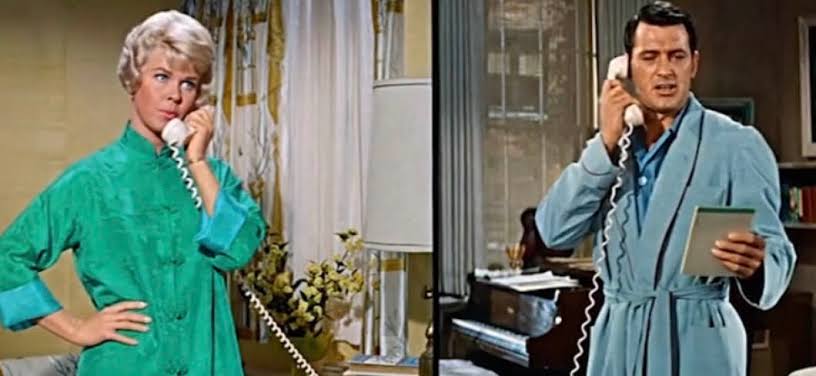
The phone call’s quality of closeness at a distance informed film composition and staging, first by the relay of editing, but then through the optical device of the split screen. More than just a simple trick for showing simultaneous or parallel action, the split-screen phone call could collapse the streets and buildings or miles separating its characters. In the same process, it could offer the intimacy – and often the eroticism – of interactions hinted at, or even unpermitted. Even on the cusp of its abandonment, I’m not sure the Production Code would have allowed Doris Day and Rock Hudson to share an actual bathtub, but they’re already doing it – at a ‘distance’, of course – in 1959’s Pillow Talk.

When 1989’s When Harry Met Sally nods to this same tradition, it’s with good reason. At the heart of the romantic comedy is a badly kept secret of the main couple’s irresistible attraction. The couple are usually the last ones to know, of course, which is why we watch them go through all the motions so innocently. And why, in that case, and thanks once more to the split screen, we get Billy Crystal and Meg Ryan sharing so much time together in bed, sharing so much pillow talk. They might not have realised (yet) that they could knock down this illusory wall, but we do, and watching them not get it straightaway is the film’s whole point and charm.
The Virgin Suicides (1999)
There’s a lovely scene in Jean-Luc Godard’s Une femme est une femme (1961) where a bickering couple, refusing to speak, argue by pointing at book titles. Sofia Coppola pulls a similar, and in a different way no less romantic trick in her adaptation of The Virgin Suicides, shot in 1999 but set in the pre-mobile mid-1970s. Coppola grasps the bittersweet combination of closeness and distance that made the landline such a fulcrum for lovelorn sweethearts in the years prior to email, facetime and texting. Imprisoned in their own home by their strict parents, the doomed Lisbon sisters connect with the world beyond through musical phone calls, relayed back and forth between them and the smitten neighbourhood boys: a dialogue-free cinematic conversation moving between the two spaces, the separation at once obvious but collapsed in the space of an edit, cued to the suitable strains of Carly Simon’s ‘So Far Away’.


Mujeres al borde de un ataque de nervios/Women on the Verge of a Nervous Breakdown (1988)
If movies are anything like real life, US presidents spent the mid-1960s nervously clutching handsets before the missiles started to fly: Peter Sellers’ Merkin Muffley in 1964’s Doctor Strangelove, or Henry Fonda’s namely POTUS in the same year’s Fail Safe. I only learned recently that the actual ‘red telephone’ connecting Washington with Moscow, and which both these films literalise, didn’t actually exist. Or at least, the phone gripped by Sellers and Fonda was a tangible image for a less visual, and therefore less cinematic, set of communication tools.


But this also made the telephone a dramatic prop, and most importantly, a proxy for the tension exploited by the cinematic close-up. You didn’t need an epic canvas to depict the theatre of war when a terrified and hopeless phone call could serve the same purpose. What’s more, the handset gave focus and legitimacy to the sight of an actor essentially talking to themselves. Conversely, the actor’s silent reaction, under the telescoping effect of the camera, could speak volumes.
Filmmakers like Alfred Hitchcock would famously turn the ringing phone into a deathtrap, in Dial M for Murder (1954), or as a fearful sign of impending threat, as in The Thirty-Nine Steps (1935). Hitchcock’s genius was to see in this ubiquitous object a weapon of terror, to the point where its cosily familiar form could become uncannily alive. In Women on the Verge of a Nervous Breakdown, Pedro Almodóvar’s different genius was to see the telephone as a fetish: an object both of devotion, and an almost eroticised substitute for the absent or unfaithful lover at the other end.

The film’s inception was an adaptation of Jean Cocteau’s short play The Human Voice: a drama, in Almodóvar’s words, about ‘a woman sitting next to a suitcaseful of memories waiting miserably for a phone call from the man she loves.’ Even if this central image from Cocteau’s play is all that remains in Women on the Verge, the telephone itself dominates the film; oversized in the foreground through forced perspective, red as a fire truck, its ring the signal for Carmen Maura’s Pepa to rush in, lunging for the receiver as if her life depended on it – which in this film, at least, is more or less the truth.

If Women on the Verge plays out like a farce, to call the film ‘theatrical’ would miss the point that Almodóvar rethinks the stage comedy in an undeniably cinematic language. It’s one created as much in the editing suite; the telephone’s fixity and weight dictating the film’s construction of cinematic space, with everything moving or relaying in relation to this central object. Not for nothing does the phone appear in so much publicity around the film both then and now – it’s basically a member of the cast.
Her (2013)
It’s interesting that when Almodóvar finally makes that version of The Human Voice in 2020, by which time the rotating-dial handset is as obsolete as the gramophone, the film dispenses with Cocteau’s original image altogether: here, a cool and impeccable Tilda Swinton uses a Bluetooth earbud that, to all intents and purposes, leaves her perpetually in contact. There is no handset to run or cling to. Connection follows her at all times.
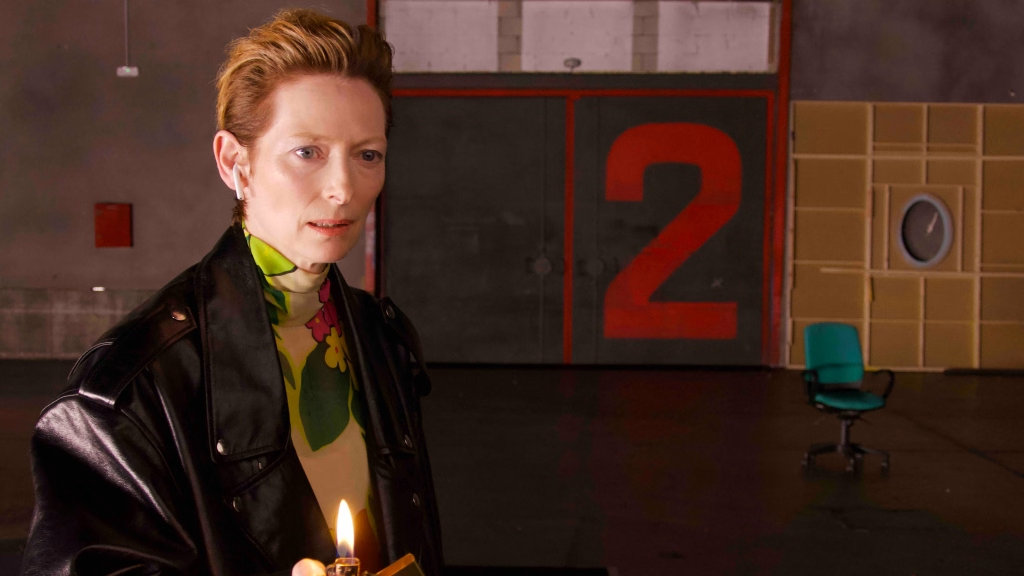
It’s as if the sight of women running for the phone in high heels, already funny in 1988, would be absurd in our modern age. But the high-tech connectivity promised in The Human Voice still requires human constancy. The almost-antiquated telephone in Women on the Verge suited the comedic mode because of its clunkiness: its imperfections could stand in for the very unreliability of romantic relationships. Mobile technologies, along with the internet, offered the notion of permanent availability and access. If the older telephone sometimes failed to connect us, this was just a symptom of life’s messiness. When modern communications fail, it feels like a fault in the universe.
This is what happens in Spike Jonze’s Her, set in a speculative future in which our phones and their sentient operating systems regulate every aspect of our lives, and to which we are permanently connected via wireless earphones. Near the film’s end, Joaquin Phoenix’s Theodore suddenly finds himself ghosted by the OS with whom he has fallen in love. He finally gets reconnected on the steps of an underpass, only to discover that his beloved is carrying on a similar and simultaneous relationship with hundreds of other users. Without anyone tangible at the other end of the line, and without even the proxy of a handset to hold onto, Jonze films the scene in a near-continuous take of Phoenix in effect talking to himself; the only other cut being to the dozens of passersby, viewed by Theodore, also talking to themselves. They’re not, of course, at least strictly speaking. But in Her, this is the inevitable comic impression, and in some ways the inevitable fate, of our hands-free, permanently connected and permanently dependent existence: the sight of a species chuntering and chattering into the void, and taking one more step towards species obsolescence.


The Bourne Ultimatum (2007)
As much as mobile phones suck, they’re not all bad. Being able to buy a pre-paid phone, sneak it into someone’s pocket and then guide them away from their own assassination is something we can only see – or at least see and almost believe – in this century. It’s also what we get in Paul Greengrass’s The Bourne Ultimatum, with the ill-fated Paddy Considine being given the runaround in Waterloo Station, and a new kind of high-stakes action scene being created in the process. Back in the day Paddy would have had to answer a payphone, assuming they still worked, and then he’d be even more of a sitting duck. Matt Damon’s game with the surveillance cameras, rush-hour commuters and the waiting shooter makes for a classic scene, and very nearly gets Paddy off the hook. I said nearly.


2001: A Space Odyssey (1968)
Homer’s great epic is no place for a telephone, so it’s one of the many comic touches of Stanley Kubrick’s own Odyssey that in 2001, his vision of the telephone should be at once so astounding and also so banal. Back in 1968 the idea of a video call might have seemed as distant and yet as tantalisingly possible as lunar space stations. This, then, is the space-age future promised by NASA’s moon programme, and what will it bring us? More of the same chat, it seems, only with the majesty of the rotating moon and the depths of space unnoticed and ignored just to the speaker’s left. Kubrick’s ironic cosmic vision would be to suggest that, with familiarity and time, even space travel, like the telephone itself, will become domesticated; and that the more connected we might become, even across stellar distances, the less of ourselves we might well understand.

References
Frédéric Strauss (ed.), Almodóvar on Almodóvar (Faber, 1996).