
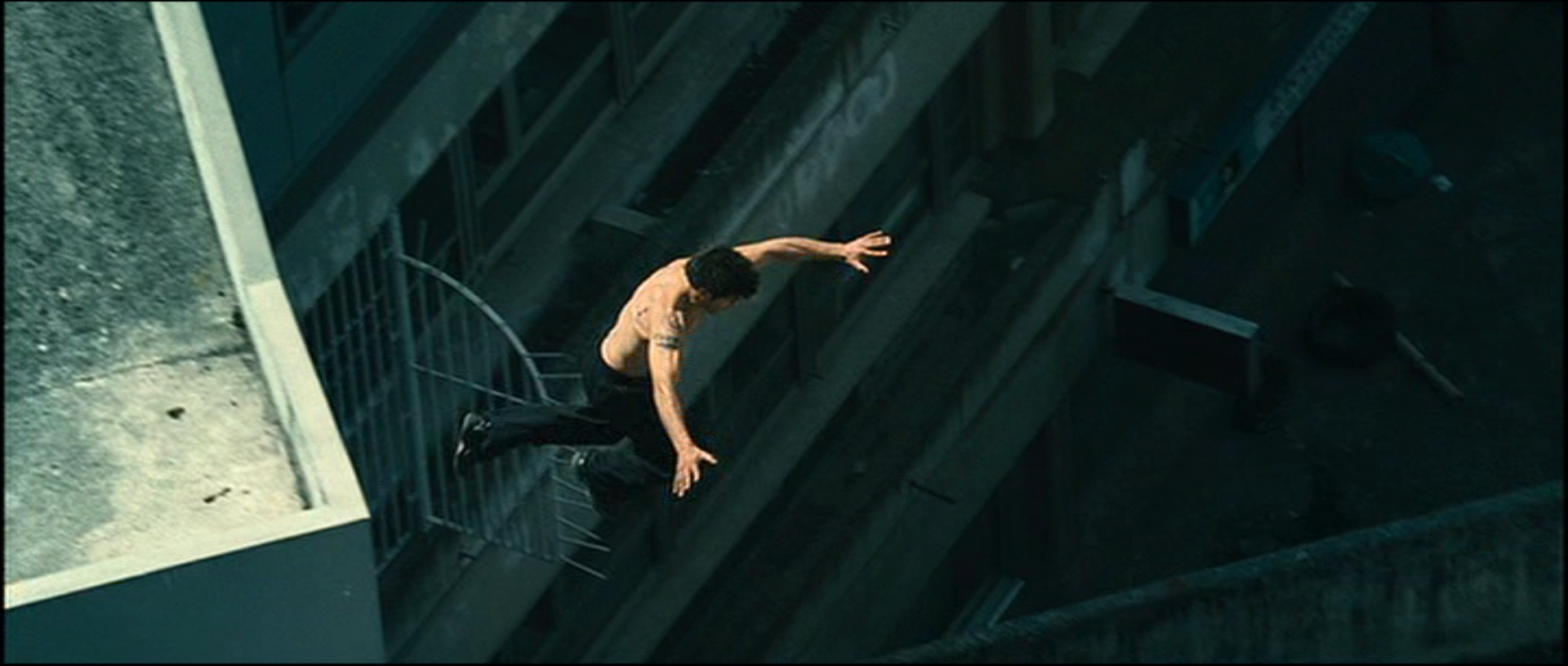
Back in 2002, the BBC ran a new ident: a ripped and shirtless guy running and jumping over London rooftops, hopping over gaps and sliding down poles, while below him the rush hour traffic groaned and crawled. The film went as near to virality as was possible in those pre-viral days. Here in the UK, at least, we’d seen nothing like it.
As we soon discovered, this was parkour – or, as similar variants would have it, free-running – and the French had been doing it for years. Yamakasi, a Paris-set movie featuring a group of young parkour traceurs, had already appeared in 2001. David Belle, the shirtless guy from the ident, would then star in Banlieue 13 (District 13) (2004), with Paris here as a near-future dystopia.
Plenty of academic ink (some of it my own) was spilled over the significance of parkour in Paris: a city redesigned in the nineteenth century as one of straight, wide and therefore easily policeable roads, all the better to manage the city’s historically rowdy rabble. And then there’s the (in)famous banlieue that circles central Paris and which lends its connotations to that 2004 film: a kind of exclusionary zone both in and outside the capital itself, often as mistrusted as it is misunderstood (and itself a frequent subject of films, such as Mathieu Kassovitz’s 1995 classic La Haine). Since the traceur could make light of walls and fences, or use the roofs when others stuck to the street, their subversive potential was obvious. They could evade whatever came at them, and where they roamed, the city was theirs.

As I’ve sketched in a new short video, parkour also changed the possibilities of the action film. It wasn’t the first sport to transform our relationship to the city: skateboarding, which can turn kerbsides and benches and all manner of everyday architecture into its playground, established a theoretical template for parkour some years earlier. But while the peculiar angles and perspectives of skate videos might capture skating’s transformations of urban space, this was harder to convert to the scope of the big-screen feature film. Parkour, by contrast, played on a larger canvas, and its practitioners didn’t need any stunt-doubles.
This idea of the rooftop runner who knew all the hidden angles – and a novel way to get from A to B – was a gift to the action chase sequence. Films like Banlieue 13 exploited the surprise of Belle’s unlikely routes around urban interiors, and the literal suspense of what looked like leaps into the void. Foucan would appear shortly after in Casino Royale (2006), outjumping and outwitting a still lumbering 007. And in the following year’s The Bourne Ultimatum (2007), parkour is the vehicle to show Jason Bourne’s automated and anticipatory sense of space, outrunning police and hunting down his prey over the rooftops of Tangiers.
It was hardly surprising too that parkour’s dynamic negotiation of the urban geography should lend itself to videogames, from Assassin’s Creed to Blink to Mirror’s Edge. And it’s one short leap from there, of course, to the infinite possibilities of the computer-animated film. But that’s for another day.
Leave a Reply